Indigenous IoT-Enabled Water Level Monitoring Sensor
 Jaison Jacob
Project Area: Water Management | Flood Monitoring | Indigenous Product Development
Project Description
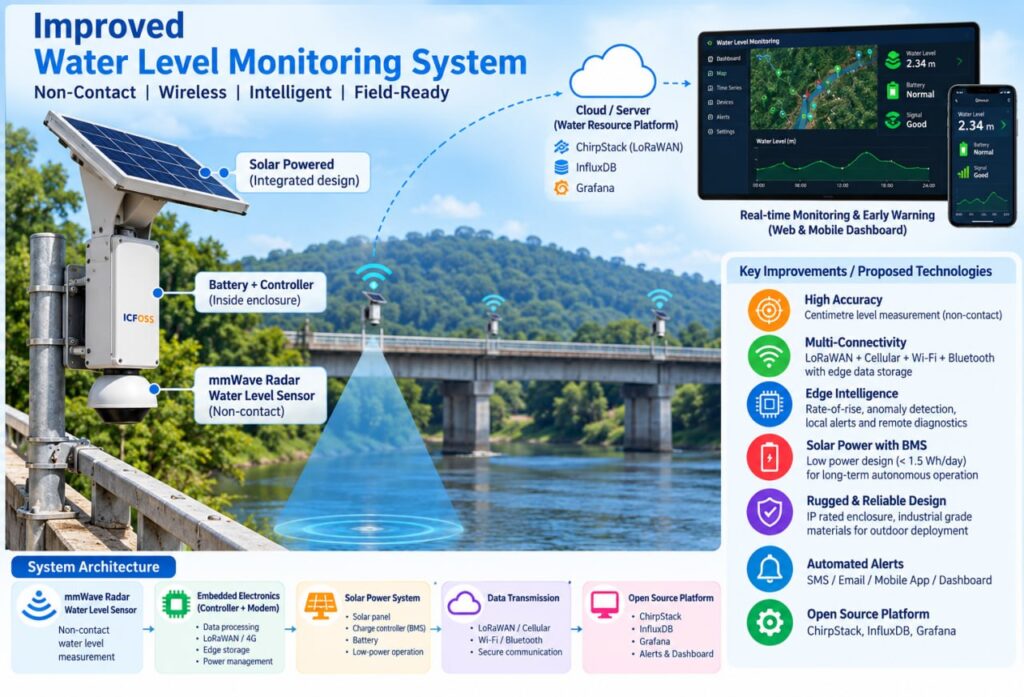
ICFOSS has developed an IoT-enabled, non-contact water-level monitoring system using millimetre-wave radar technology for continuous monitoring of rivers, canals, drainage networks, and other water bodies.
The system addresses the need for affordable and reliable water-level measurements, particularly in locations where manual observations are difficult and contact-based sensors are exposed to debris, sediment, and environmental deterioration.
The existing technology uses an mmWave radar sensor to measure the distance between the installed sensing unit and the water surface. The recorded measurements are transmitted through LoRaWAN communication to a centralised monitoring platform.
The system incorporates solar-assisted power, rechargeable battery backup, embedded electronics, and open-source software infrastructure. ChirpStack is used for LoRaWAN network management, while Grafana provides visualisation of water levels, historical trends, and monitoring information.
The current field-tested prototype is at Technology Readiness Level 6, with a reported measurement range of 0.5–10 metres and an approximate measurement accuracy of 1 cm, subject to further reference-based validation.
The technology has been used in water-level monitoring applications associated with Nemom Block Panchayat, Technopark, and the Irrigation Department, Kerala.
Building on this experience, ICFOSS is pursuing improvements in radar calibration, industrial-grade electronics, power management, communication flexibility, device diagnostics, and weather-resistant enclosure design.
The proposed product development also includes edge-based threshold detection and rate-of-rise monitoring to support local early warning applications.
Technologies: mmWave radar, embedded controllers, LoRaWAN, ChirpStack, Grafana, solar power, battery management, sensor calibration, and embedded monitoring algorithms.
Location: CDOH Lab, Thiruvananthapuram; field applications at Nemom, Technopark, and Irrigation Department monitoring locations across Kerala.
Associated Organisations: ICFOSS–CDOH, with field implementation experience involving Nemom Block Panchayat, Technopark, and the Irrigation Department. IIT Bombay RuDRA Lab and IICT are identified collaborators for the proposed product development.
Project Activities: Sensor development, hardware and firmware integration, calibration, LoRaWAN telemetry, laboratory testing, field deployment, and product engineering.
Expected Impact: Affordable, non-contact water-level monitoring for local self-governments, water-resource agencies, urban infrastructure, and disaster preparedness applications.