Tracking Pollution Patterns: NavIC-Empowered City Air Quality Surveillance with Energy Harvesting
 Gopika T G
Project Area: Environmental Monitoring | Smart Cities | IoT
Project Description
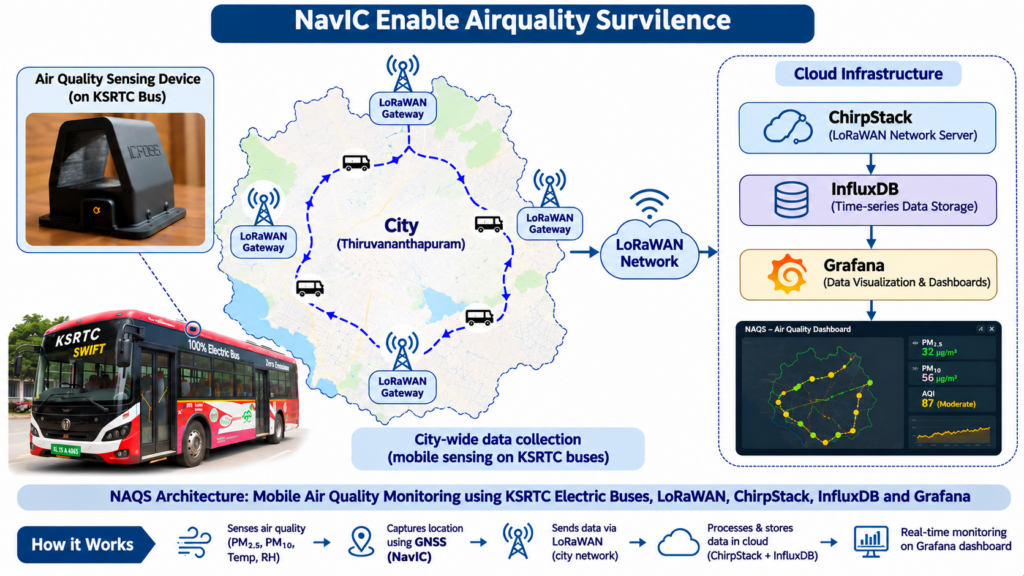
The Centre for Development of Open Hardware (CDOH) at ICFOSS is developing an indigenous, energy-efficient urban air quality monitoring system that combines NavIC satellite navigation, IoT communication, and ambient energy harvesting technologies.
The project addresses the limitations of conventional stationary air quality monitoring systems, particularly their restricted spatial coverage and the cost of establishing dense monitoring networks.
The proposed solution includes both static and moving air quality monitoring devices. Moving devices are designed for installation on public transport vehicles to collect location-specific pollution measurements along urban routes. NavIC-based positioning enables the collected measurements to be associated with geographical coordinates for pollution mapping and identification of areas with elevated particulate concentrations.
The system incorporates particulate matter sensors for PM1, PM2.5, and PM10, environmental sensors, embedded controllers, and LoRaWAN communication for low-power wireless data transmission. Solar and wind energy harvesting systems are being evaluated to reduce dependence on external power and improve operational autonomy.
The development work includes prototype fabrication, firmware integration, energy harvesting experiments, sensor comparison studies, field data collection, and geographical visualization of pollution patterns.
The project aims to support urban environmental monitoring, research, pollution hotspot identification, and evidence-based environmental management.
Technologies: NavIC GNSS, LoRaWAN, ESP32-S3, LoRa-E5, BMV080 particulate matter sensor, environmental sensors, solar and wind energy harvesting, embedded firmware, GIS, and open-source dashboards.
Location: Thiruvananthapuram City, Kerala; prototype development and field evaluation at CDOH Lab and selected urban routes.
Associated Organizations: ICFOSS–CDOH and IIT Tirupati Navavishkar I-Hub Foundation (IITTNiF).
Project Activities: Sensor integration, moving and stationary monitoring prototypes, energy harvesting evaluation, communication network development, reference-sensor comparison, and field testing.
Expected Impact: Improved spatial coverage of urban air quality monitoring, reduced operational dependence on conventional power sources, and availability of location-specific environmental data for research and planning.